
Survival Guide: Staying Alive in the Complex
Quick answer
You survive Backrooms: Code Yellow by treating depth as a dial you control, not a distance to conquer. The developer's own framing: you decide how deep into the complex you explore to collect data, "but it will get dangerous." Everything below follows from that one idea.
Danger scales with depth
- The further a team pushes, the worse the encounters get. Exact rewards by depth are not published here; choose depth around your return route rather than an assumed payout multiplier.
- Nothing forces you deep. First funding runs can stay in the shallower zones while the squad learns its tools.
- The complex changes as you travel - zones shift colour and furniture the further you get. The world guide breaks that down.
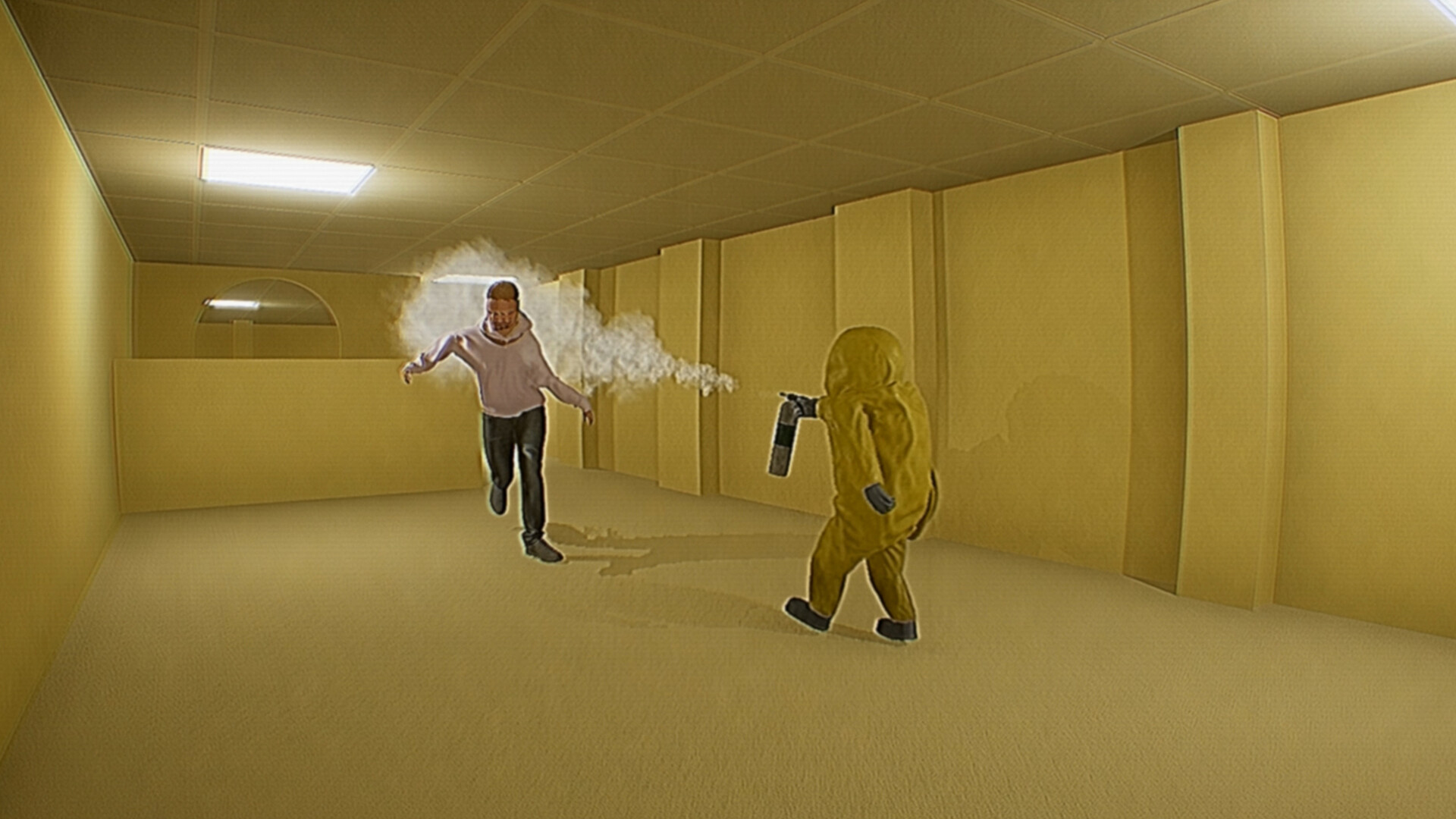
The entities - and the things that just stand there
The developer sorts your research subjects into life forms, still lifes and entities, and the official material shows why the vocabulary matters: not everything you meet is obviously alive. Working reads from launch week:
- Treat any human shape at distance as unknown until a recorded frame or a proper look proves otherwise.
- Recording an entity is a task in itself. If it is standing still and wrong, film it before you flee.
- You can fight back briefly while free to act. A launch-day patch added punching: hits soft-stun an entity, and sustained punches eventually hard-stun it for a short time - enough to break contact and get clear. Patch #16 disables unintended punching while an entity has grabbed you. Do not rely on that old behavior as an escape method. Filming it is still the job.
- Patch #6 (Sep 26) stopped entities camping the spawn through the door. Treat the doorway as safer than it was on launch day, not as a guarantee.
- A calm room does not mean a calm area. Points of interest are hand-tuned, but their locations are not.
Getting back alive
- Turn around with margin. Leave the deep zone while the squad is still fresh, not when it is already limping.
- Protect the retreat. Note landmarks on the way in; the way out is the same route backwards.
- Never let the recorder fall behind. The person holding the documentation is the run's actual payload.
- Regroup before transitions. Every time the environment changes, the team stops and counts heads.
Accessibility: camera shake
After a player raised motion sickness, the developer confirmed a camera-shake option is coming. If shaky-cam games usually bother you, check the settings after each patch - and until it lands, keep runs short.
Squad discipline
- Pair up for everything. Two players cover each other; a solo straggler is a rescue mission waiting to happen.
- Nominate one recorder and one navigator per dive so neither job depends on luck.
- Call the turnaround together. The run ends at the planned depth, not at the first scary noise.
Still unconfirmed
A full entity list, difficulty options and exact death penalties are not documented yet. When the community maps them properly, they land on this page first.
Recheck pursuit and settings on the current build
Entity speed increased in Patch #14, then was slightly reduced in Patch #15. Do not use a launch-day clip as proof that your crew can outrun every encounter. The notes give no safe distance or exact speed, so keep an open retreat route and regroup before pressing farther in.
The temporary 144 FPS cap from #15 is followed by the FPS Limit setting in #17. Set a stable limit before a run, and test the new Push to Talk setting while the crew is still together. If changing settings removes the UI, #18 fixes that main-menu bug; update before continuing the dive.
Camera-shake support was discussed previously, but #17 names only Push to Talk, FPS Limit and Mouse Sensitivity. Check the current menu rather than treating a promised accessibility option as shipped. See patch notes for the dated changes.
Sources: official update feed, Patch #16, #17, #18. Checked October 4, 2026.